
Site Evaluation: The Value for Money Siting Factor
by Matt Swift, Senior Project Manager at Nuclear Waste Services
Site Evaluation
Site Evaluation is a crucial step in the journey toward identifying a suitable location for a Geological Disposal Facility (GDF). It informs the Site Suitability Perspective – one of three key perspectives in the Decision Making Framework that guides Nuclear Waste Services (NWS) in key siting decisions including deciding which communities may progress to deep borehole investigations.
Through detailed studies based on the Six Siting Factors and 26 Evaluation Considerations in the Site Suitability Perspective, NWS assesses and evaluates whether a GDF can be designed, constructed, operated, and closed safely.
One of the Six Siting Factors is the Value for Money Siting Factor.
As part of its Site Evaluation studies, NWS needs to understand whether the delivery of a GDF at a particular location could offer Value for Money, considering local, regional and national economic factors. The Value for Money Siting Factor uses information provided by the five other Siting Factors – Engineering Feasibility, Safety and Security, Community, Transport, and Environment, as well as wider information – to understand the potential timescales, costs and benefits involved in delivering a GDF at a given location.
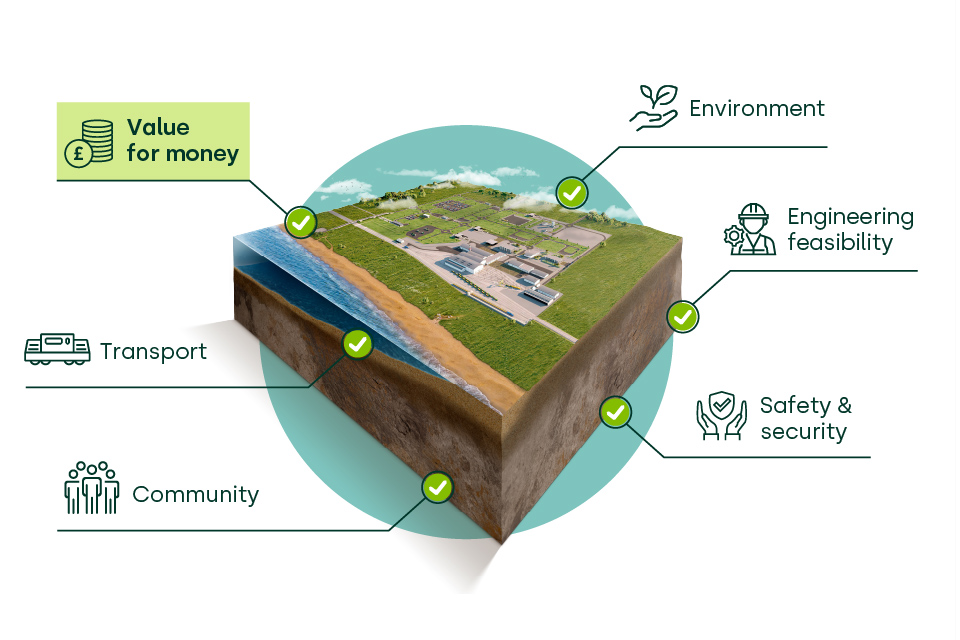
The Value for Money Siting Factor considers:
Lifetime Costs and Value: The costs and benefits of the investigation, construction, operation and closure of a GDF.
Waste Receipt Schedule: The implications of investigation, construction and operational timescales on the readiness of a GDF to accept different types of waste.
Why Areas of Focus matter when considering Value for Money
NWS has identified smaller Areas of Focus within the Search Areas, and the inshore area beyond the coast, to guide the Site Evaluation studies and help prioritise resources for assessing the potential of each area to safely host a GDF.
The characteristics of the three distinct Areas of Focus – Surface (the facilities and infrastructure above ground), Sub-surface (the underground disposal area within the host rock) and Accessways (the connections between Surface and Sub-surface facilities) – will influence the timescales, costs and benefits associated with the delivery of a GDF.
Examples that could influence Value for Money considerations include:
- The nature of potential surface site terrain, layout and the degree of flexibility offered.
- Construction methods and the level of technical challenge expected during development of the accessways and underground disposal areas.
- Work needed to manage or eliminate environmental risks, for example the introduction of flood protection measures.
- Work needed to make necessary infrastructure and utilities connections and upgrades, for example rail spurs.
What’s next in assessing Value for Money?
Understanding the cost and benefit implications of hosting a GDF at potential sites takes time.
The next stage of the programme, Site Characterisation, would involve drilling boreholes to better understand the rock types and ground conditions where a GDF could be built. Site Characterisation is expected to take approximately 10 years.
During this time, as our understanding of potential surface and underground locations are refined, and geological characteristics become better understood, site-specific designs will be developed. This will enable the development of more detailed delivery plans, cost estimates and benefit realisation plans.
The results of Site Characterisation work will provide NWS with a greater understanding of Value for Money, reducing cost and schedule uncertainty and helping to inform a decision about the preferred location for a GDF.