
Site Evaluation: The Safety and Security Siting Factor
by Kurt Smith, Senior Safety Case Engineer at Nuclear Waste Services
Site Evaluation
Site Evaluation is a crucial step in the journey toward identifying a suitable location for a Geological Disposal Facility (GDF). It informs the Site Suitability Perspective – one of three key perspectives in the Decision Making Framework that guides Nuclear Waste Services (NWS) in key siting decisions including deciding which communities may progress to deep borehole investigations.
Through detailed studies based on the Six Siting Factors and 26 Evaluation Considerations in the Site Suitability Perspective, NWS assesses and evaluates whether a GDF can be designed, constructed, operated, and closed safely.
Safety and Security Siting Factor
One of the Six Siting Factors is the Safety and Security Siting Factor. Protecting people and the environment is our highest priority. A Geological Disposal Facility (GDF) will only be built if it can be shown to be both safe and secure.
The Safety and Security Siting Factor plays a central role in evaluating whether or not a potential site meets these essential requirements.
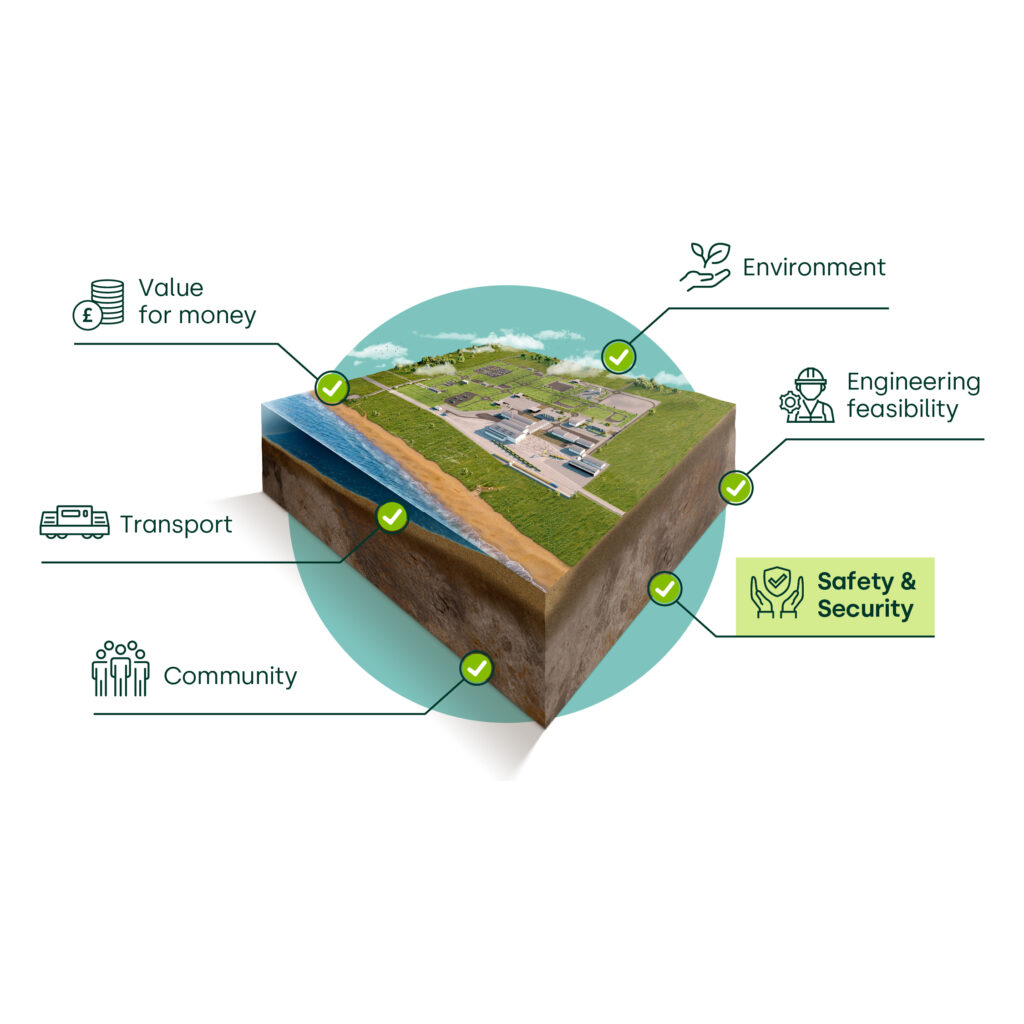
A unique feature of a GDF is the role of geology in delivering safety. A GDF needs to safely isolate and contain the UK’s most hazardous radioactive waste deep underground for hundreds of thousands of years.
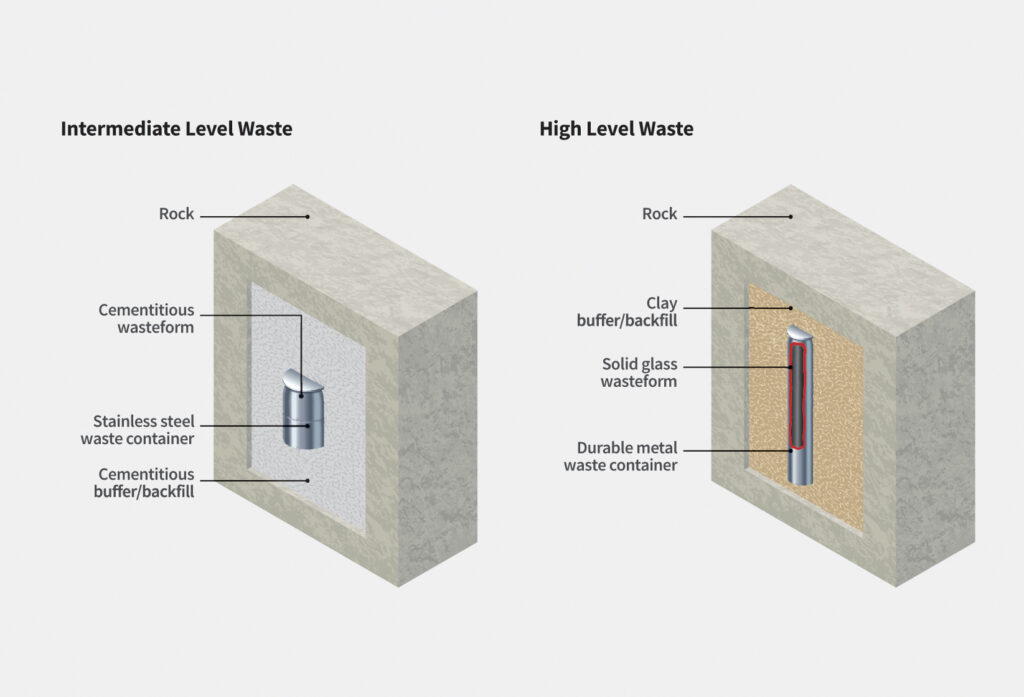
Achieving long-term safety of a GDF relies on a combination of the natural geology and the engineered design in what is known as a multi-barrier approach. As such the Safety and Security Siting Factor is closely linked with the and Engineering Siting Factor.
Multi barrier design
Safety Factors
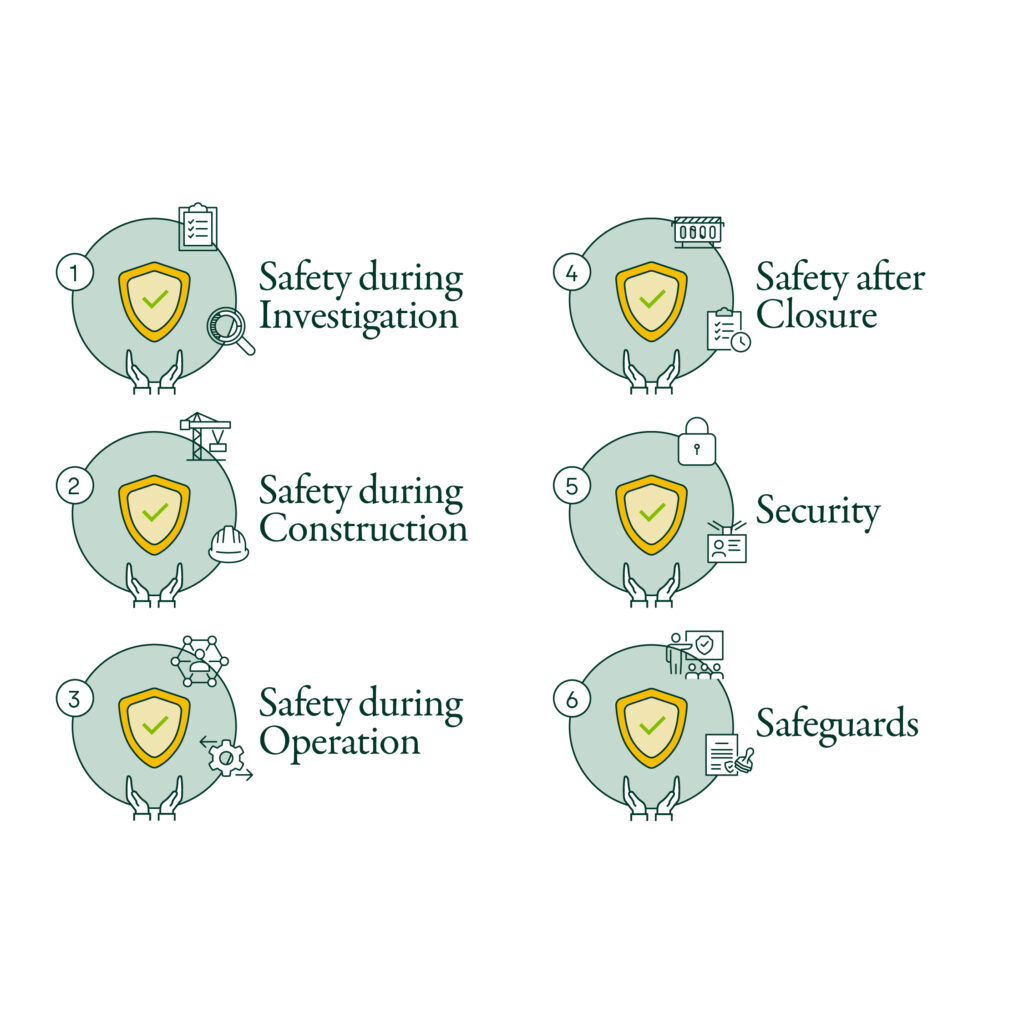
As part of Site Evaluation, the Safety and Security Siting Factor considers:
- Safety during Investigation – can we characterise the site through borehole investigations safely,
- Safety during Construction – can all aspects of the GDF be constructed safely,
- Safety during Operations – can a GDF be operated safely over the lifetime of the GDF,
- Safety after Closure – will the GDF safely isolate and contain the wastes from people and the environment long after the GDF has been closed,
- Security – can a GDF be protected from threats ensuring public safety,
- and Safeguards – can a GDF prevent the misuse or diversion of nuclear materials.
The safe transport of nuclear materials is also very important and is considered separately as part of the Transport Siting Factor.
See Site Evaluation – How we will evaluate sites in England for more information on the Safety and Security Siting Factor considerations.
What studies have we carried out so far?
A GDF requires a sub-surface facility, surface facility, and accessways to connect them. NWS has identified smaller Areas of Focus which enable us to look at safety and security in more detail and consider whether these potential areas are suitable or not for hosting a GDF.
Sub-surface
The sub-surface geology plays a critical role in how a GDF provides long-term safety by containing and isolating the waste from people and the environment. As we are in the early stages of the GDF programme, our understanding of the sub-surface geology is being derived largely from desk-based studies. These early studies are focusing on identifying potentially suitable host geologies, which may include mudstones or evaporite formations. Some of the most important characteristics of the geology for long-term safety are permeability – a control on how water flows through the rock – and the depth of the host rock. These are key to ensuring containment and isolation of the wastes over very long timescales.
Surface
Our studies have looked at local characteristics and surface conditions of the surface Area of Focus to understand how they might affect the safety and security of a GDF at each stage of its development.
This has included considering: the local topography and how it could affect the security of a site; emergency planning arrangements associated with local industry; and potential hazards including natural events like earthquakes, flooding, and severe weather, as well as human activities such as nearby construction, mining, and the running of other local infrastructure.
We have used knowledge from the International Atomic Energy Agency, the Office for Nuclear Regulation and many other similar national and international organisations to underpin our work.
Accessways
The accessways – a corridor within which the surface site could be connected to the sub-surface – are central to construction safety, and the safety of the operations to emplace the waste underground. We need to understand the local geology to be able to establish the most suitable routes the accessways could take, and importantly, how we could construct tunnels in those conditions safely.
What happens next?
The initial feasibility studies completed so far represent the early stages of Site Evaluation. As we move forward, we will bring together the information gathered from our studies and evaluate what it means for the feasibility of building a GDF in the Search Area and for safety and security throughout the lifecycle of a GDF.
During Site Characterisation, detailed investigations including deep boreholes, would be undertaken to better understand the area’s geology. Approximately 10 years of Site Characterisation and supporting research will inform the development of the GDF design and Safety Case. Ultimately, our goal is to demonstrate to the regulators, community, and the wider public that a GDF will be and will always remain safe.