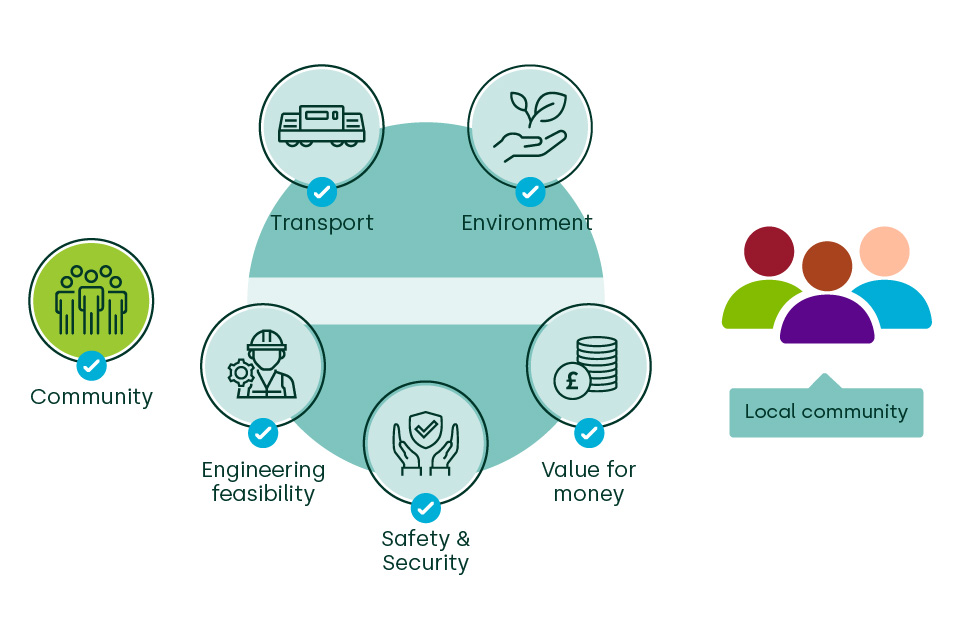
Site Evaluation: The Community Siting Factor
by Stephen Brown, Senior Research Manager (Social Science) at Nuclear Waste Services
Site Evaluation
Site Evaluation is a crucial step in the journey toward identifying a suitable location for a Geological Disposal Facility (GDF). It informs the Site Suitability Perspective – one of three key perspectives in the Decision Making Framework that guides Nuclear Waste Services (NWS) in key siting decisions including deciding which communities may progress to deep borehole investigations.
Through detailed studies based on the Six Siting Factors and 26 Evaluation Considerations in the Site Suitability Perspective, NWS assesses and evaluates whether a GDF can be designed, constructed, operated, and closed safely.
Community Siting Factor
Within the Community Siting Factor, it is important we consider the impact of a GDF on the wellbeing of the community, including social, economic and health circumstances. The host area must have, or be supported to develop, the attributes needed to accommodate the project, and deliver a positive, lasting community legacy.
Our assessments will need to take into consideration relevant plans, strategies and polices that may relate to an area, such as local economic strategy or local development plans.
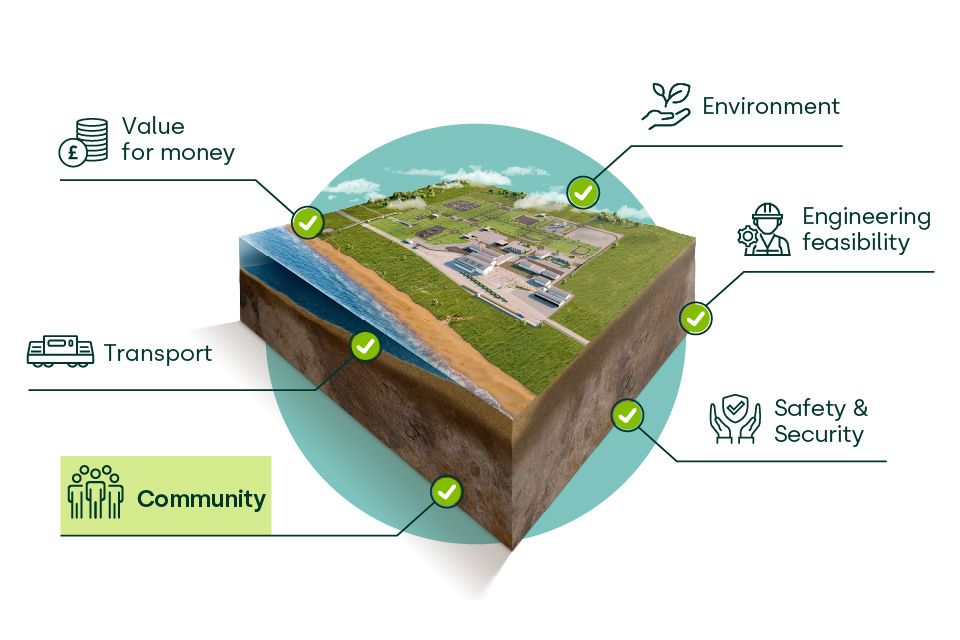
The Community Siting Factor considers how the investigation, construction, operation and closure of a GDF could affect the following:
- Community wellbeing, including the social, economic, environmental, and cultural conditions that people and their communities say they need to fulfil their potential. The wellbeing profile of a community includes aspects such as community cohesion and cultural identity.
- Social conditions, looking at how communities function and interact with each other to meet their needs. This includes the type and numbers of the local housing stock, housing capacity, demographics, access to services, social infrastructure and facilities, and levels of deprivation and crime.
- Economic considerations, including the performance of the local economy, the sectors important to the prosperity of the community, the key sectors which shape it, major local employment providers, the size and skills of the local workforce, and travel to work patterns.
- Health considerations, looking at the physical and mental health characteristics of a community. This includes consideration of access to health and social care services, the capacity of local services that support health, social care and leisure activities, access to open spaces, transport, education and employment, air quality and noise, and the landscape and visual environment.
- Consideration of a local Community Vision – the long-term aspirations a community wants to secure for itself, and the alignment of a GDF with the local vision and strategic objectives of the community. The focus of this work is within the Search Areas, while also considering the wider regional vision of the local authority.

NWS’ assessments will consider potential benefits as well as disbenefits which may arise because of delivering a GDF, and any potential mitigations. For example, the availability of a local workforce and any training needs that may be needed to support this, the capacity of existing health and social care services and infrastructure, and the need for any improvements that may be required to support health, social care and leisure activities.
What are the initial studies you are carrying out?
We need to understand the current characteristics and potential future changes in and around each Search Area.
The Search Areas we’re exploring on land and in the inshore area beyond the coast, are large and varied. We have identified smaller Areas of Focus to guide the Site Evaluation studies and help prioritise resources for assessing the potential of each area to safely host a GDF.
Within the Community Siting Factor, we also look beyond the Surface Areas of Focus to a sixty-minute Travel to Work Area to help us understand the locations, economic assets and social groups which could be impacted by the development of a GDF.
What happens after the initial Community studies?
This work will give NWS a better understanding of the local community and contribute to NWS’ decision on whether a community is taken forward to Site Characterisation, including deep borehole investigations to understand the geology underground.
Site Characterisation investigations and supporting research could take approximately 10 years, and the information gained from this work will inform the development of the GDF design and the Safety Case.
Additionally, before we can undertake Site Characterisation work, we will need to carry out an Environmental Impact Assessment.
That Environmental Impact Assessment will be a core part of our applications for a Development Consent Order (DCO) and environmental permits. We cannot start Site Characterisation works until the relevant regulators and Planning Inspectorate grant those consents. The Community Siting Factor considerations will make a significant contribution to an Environmental Impact Assessment and complementary Equality Impact Assessment.
During this time, as the development of the GDF design develops, the Community Siting Factor will build a better understanding of how the other siting factors, such as Engineering Feasibility , Transport and Environment will influence the future of the Community. NWS will use this information to understand how a GDF within a community could operate on a day-to-day basis, including what will be required from the local area to enable operations. This will ensure that we can mitigate against potential impacts of a GDF and secure new and sustained benefits for the community.